
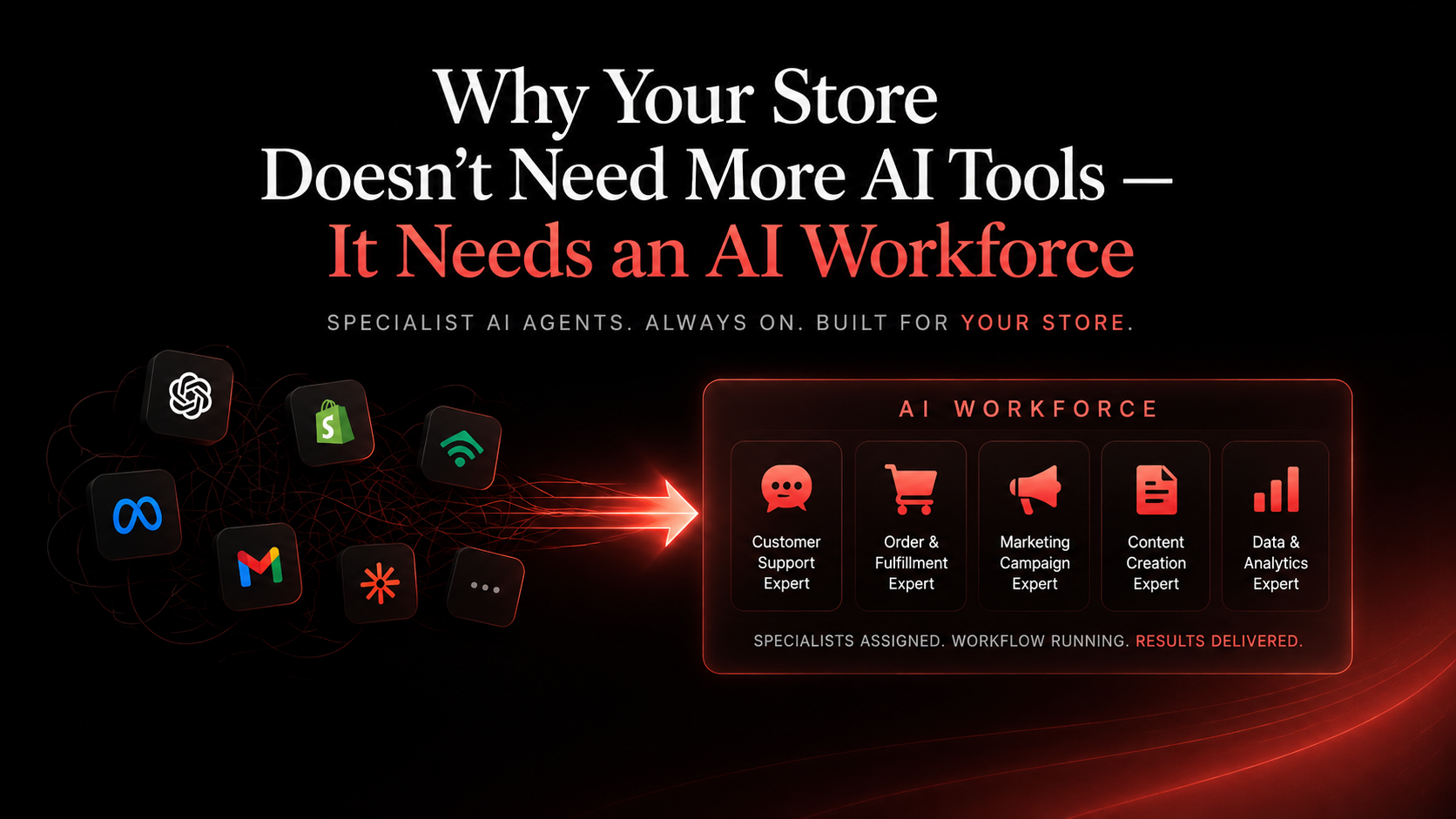
A typical Shopify merchant in 2026 has ChatGPT for product descriptions, Shopify Magic for emails, Klaviyo’s AI for flow content, Meta’s Advantage+ for ads, and three other “AI-powered” apps connected to their store. They still feel behind on AI.
Why does adopting more AI tools make merchants feel less capable, not more? This essay walks through what’s actually going wrong — and a different way of thinking about AI for ecommerce.
The merchant’s AI shelf is full. Their store hasn’t changed.
Take a closer look at how those tools are actually being used.
ChatGPT writes product descriptions, but the merchant tweaks every output before it goes live, because the model doesn’t know the brand voice or the product line. Shopify Magic drafts a passable welcome email, but it sounds like every other store on the platform. The Klaviyo AI suggests subject lines, but only when the merchant remembers to click into the panel. Meta’s Advantage+ is mostly a black box. Three other apps were installed during a flash deal in late 2025 and now sit idle.
The pattern is consistent across stores. Every tool is reactive. It waits for the merchant to type a prompt, click a button, or open a dashboard. Nothing keeps running on its own. Nothing reaches across channels. Each tool solves a sliver of one workflow.
Researchers studying knowledge workers have called this the “context-switching tax” — the cognitive cost of jumping between tools without meaningful continuity. For a solo store operator, the tax is paid in hours that don’t show up on any dashboard.
Why generic AI fails ecommerce
The fact that more tools don’t add up to more leverage isn’t a coincidence. It’s a structural mismatch. Three root causes show up in almost every merchant story.
The first is the blank-canvas tax. A generic chatbot doesn’t know your store. Every prompt requires you to re-supply the context: this is the brand voice, this is the product, this is the customer, this is the policy. Over hundreds of prompts a month, the cost adds up — both in time and in inconsistency.
The second is the reactive pattern. Generic AI tools wait. They wait for a prompt, a click, a manually pasted spreadsheet. A real online store doesn’t wait. Customers send tickets at midnight. Inventory ticks down in the middle of the day. Competitors run promotions on a schedule that has nothing to do with when you happen to open ChatGPT.
The third is the integration gap. Most AI tools see one channel — usually the one the tool was built for. A real store lives across Shopify, Gmail, Messenger, Zalo, Telegram, Discord, Slack, Notion, and a few ad accounts. An AI tool that can only see one of those is, by design, half-blind to what’s actually happening.
The takeaway from these three: generic AI is a co-pilot for a single task. What an online store actually needs is an autonomous specialist for an ongoing job.
A different mental model — specialists, not chatbots
Here’s a shift in framing that changes how this problem looks.
Think about how you actually grew your store. You didn’t hire one generalist who could “do anything.” You hired specialists — a fulfilment lead who owns shipping, a Meta ads buyer who lives inside Ads Manager, a content writer who knows the brand voice, a support rep who speaks the customer’s language. Each role was scoped, each person ran their function continuously, and you managed them like a team.
The same model applies to AI. Instead of one chatbot that does everything badly, you build a small AI workforce: specialist agents, each scoped to a role, each running continuously, each integrated with the right channels.
That’s the gap between where most stores are today and where they could be — not more tools, but specialists doing specific work.
Introducing ClawExperts
ClawExperts is a platform of specialist AI agents — called experts — that you manage like software. Each expert is trained to handle a specific ecommerce workflow end-to-end, from reading the input data to taking the action and reporting back.
The difference from a chatbot is structural, not cosmetic. A chatbot is a co-pilot you summon when you remember. An expert is a worker you assign once, and it runs the role from there — monitoring its channel, executing the workflow on the schedule you set, and escalating to you only when judgment is required.

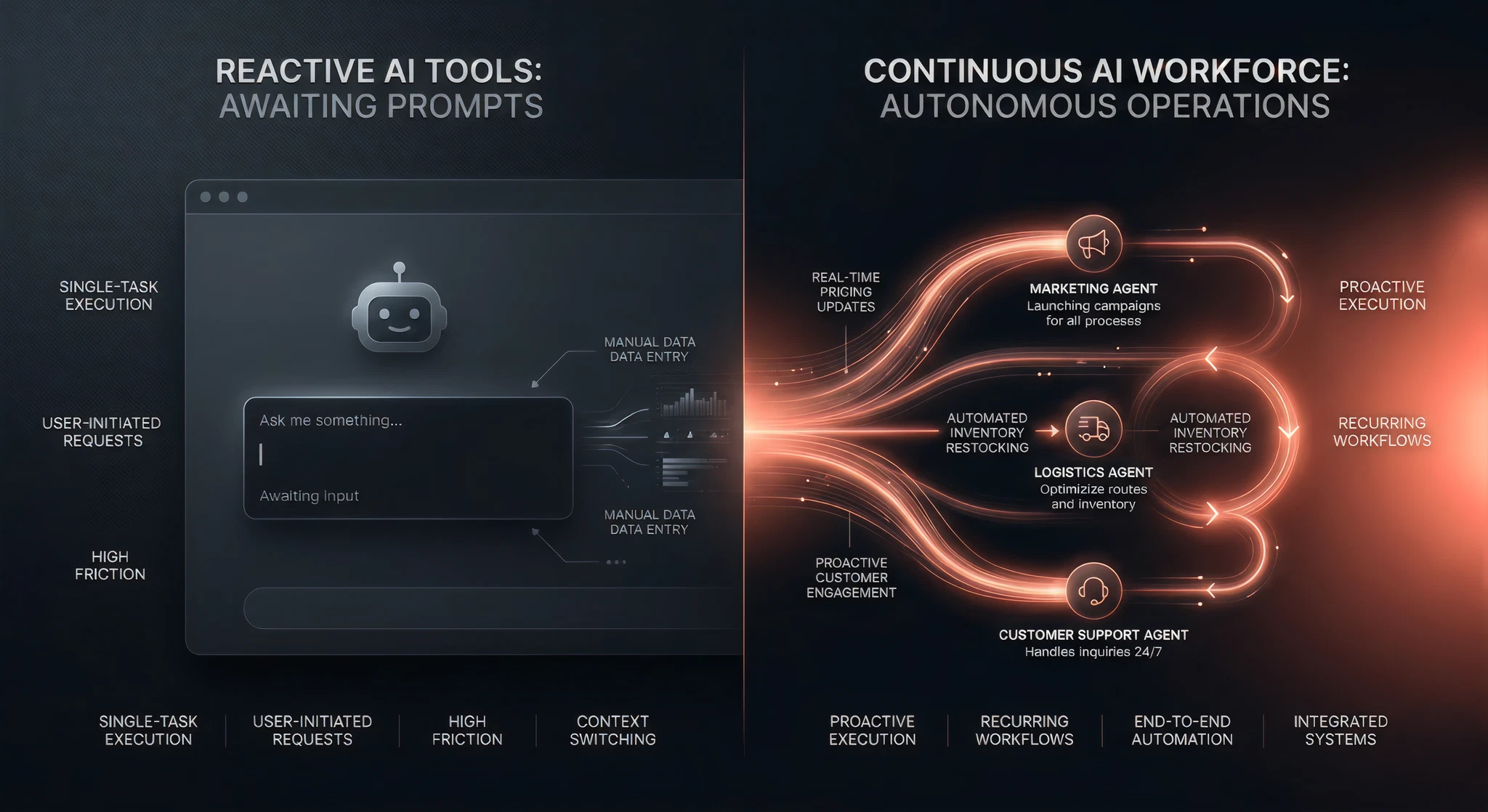
In other words, ClawExperts isn’t another AI app you install on top of Shopify. It’s a workforce layer that sits over your existing stack.
What an AI workforce actually looks like
A few capabilities make the workforce model concrete.
Reusable workflows. You define a task once — say, “every time a new SKU is added, generate a description, alt text, and translation, then post to draft” — and the expert reuses that workflow for every future SKU. You don’t re-prompt. You don’t re-explain context. The work compounds.
Custom skills. If your store has a workflow that doesn’t fit any pre-built expert, you can define your own. Upload a skill, attach it to an expert, and that capability becomes part of your workforce. This is the part most relevant to brands with idiosyncratic processes: a unique returns flow, a distinctive content approval chain, a localized loyalty program.
No API plumbing. A common reason merchants give up on AI automation is that hooking up integrations requires a developer. ClawExperts is built to remove that step. Connecting Gmail, Shopify, Slack, Telegram, GitHub, Linear, Notion, Trello, or Discord doesn’t require API keys or webhook configuration. You authorize, you assign, and the expert reaches across them.
Team handoff. The work an expert does isn’t trapped on one merchant’s laptop. Workflows can be shared across a team, so the founder who set up the support expert doesn’t have to be the one logging in to manage it next quarter.
The platform itself runs on a private cloud, with each merchant’s environment isolated. Customer data isn’t shared with other tenants and isn’t used to train AI models — a baseline that should be table stakes for anything touching ticket content or order data.
What this looks like in practice
Abstractions help only so much. Four scenarios from real ecommerce operations make the workforce model concrete.

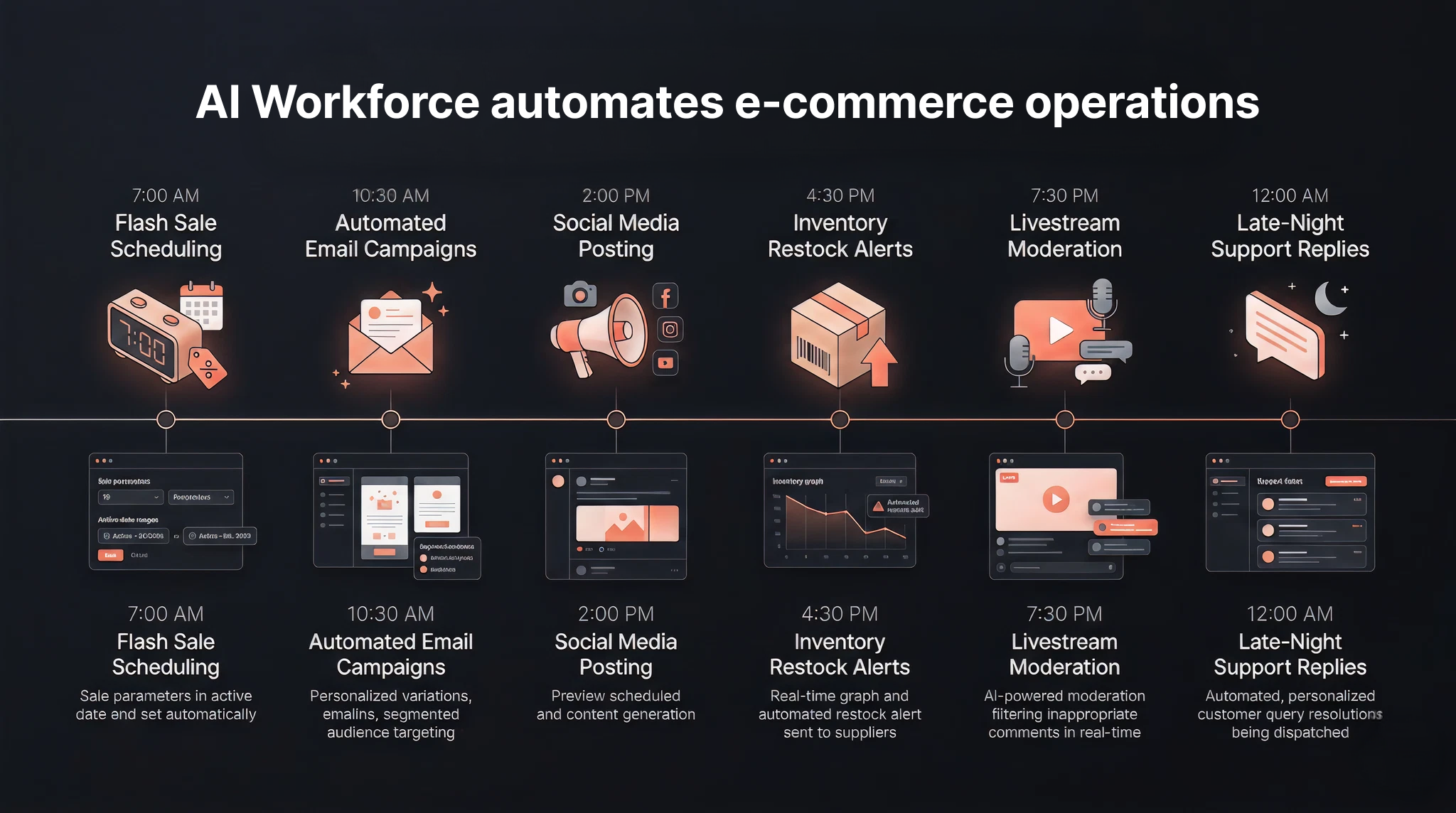
The 9 a.m. Saturday flash sale. A fashion store runs a flash sale every Saturday morning. Without specialists, someone has to manually update Shopify pricing, post on Instagram and Facebook, schedule the Klaviyo email, and queue the Meta ads. Every Saturday. With ClawExperts, a Flash Sale Scheduling expert orchestrates the whole sequence from one assigned task — pricing change at 8:55 a.m., social post at 9:00 a.m., email at 9:05 a.m., ads live at 9:10 a.m. — and the founder gets their Saturday morning back.
The “back in stock” moment. A bestseller hits restock at 2 p.m. on a Tuesday. Without specialists, someone has to remember to email the waitlist, post on socials, and update the product page. Most stores miss the window by a day or two. With a Restock Notification expert watching inventory, the email goes out within minutes of the SKU coming back online, the social posts auto-publish, and the conversion is captured while interest is still warm.
The Saturday-night livestream. TikTok Live and Facebook Live are now central revenue channels for many DTC brands. A 90-minute livestream generates hundreds of comments — questions about sizing, requests for restocks, repeated FAQs, and a smaller number of actual buying signals. Without specialists, a co-host tries to triage in real time and misses most of the leads. A Live Comment Posting expert handles the repetitive comments automatically, in the brand’s tone, and flags only the comments that look like genuine purchase intent.
The 11 p.m. support ticket. A customer in Singapore messages at 11 p.m. on a Sunday with a sizing question. Without specialists, the ticket sits until Monday morning, by which point the customer has either bought from a competitor or moved on. With a Customer Reply expert covering Shopify Inbox, Messenger, and Zalo in the store’s tone, the question gets answered in minutes — and the order goes through that same night.
These aren’t hypotheticals. They’re patterns merchants on the platform run today. The common thread is that none of them require a developer, a prompt engineer, or a daily check-in. The work just runs.
What it costs
The cost of starting is mostly the cost of attention.
Setup time is in the range of a few minutes. Pricing is tiered monthly to match workload, and the platform offers a refund window for merchants who try it and decide it isn’t a fit. The financial cost of testing the workforce model is bounded. The financial cost of not testing it — another quarter of context-switching across half-used tools — is harder to measure but rarely smaller.
A quieter way to use AI in your store
The promise of AI in ecommerce was never supposed to be that merchants would become full-time prompt engineers, stitching together half a dozen reactive tools and feeling vaguely guilty about not using them well enough.
The fix isn’t more tools. It’s specialists doing specific work, on schedule, across the channels your store actually lives on. That’s what an AI workforce looks like — and that’s the model ClawExperts is built around.
If you’d like to see what your own AI workforce could look like, the full library of experts is at https://clawexperts.com/.
Frequently asked questions
How is ClawExperts different from a Shopify chatbot app? A Shopify chatbot replies to customers in one channel. An expert on ClawExperts is closer to a remote team member — assigned a role, running continuously, integrated with whichever tools the role requires. Replying to customers is one possible role; many experts never touch a chat at all.
Do these experts learn my brand voice? Yes, within the scope of how you configure them. You can supply tone guidelines, sample outputs, and reference materials so an expert writes the way your store writes. Like any new team member, the early outputs benefit from a quick review pass; results stabilize as the configuration is refined.
Can I add a custom expert for a workflow that’s specific to my store? Yes. ClawExperts supports custom skills, so a workflow unique to your store — a particular returns process, a localized loyalty program, a hand-rolled content approval chain — can be encoded as its own expert. For more involved workflows, the team accepts custom requests.
Is customer data safe? Each tenant runs in an isolated environment. Data is not shared with other tenants and is not used to train AI models. As with any platform handling order or message data, merchants should still review the platform’s policies against their own privacy requirements.